Example
Hamburg, the planetarium in a water tower
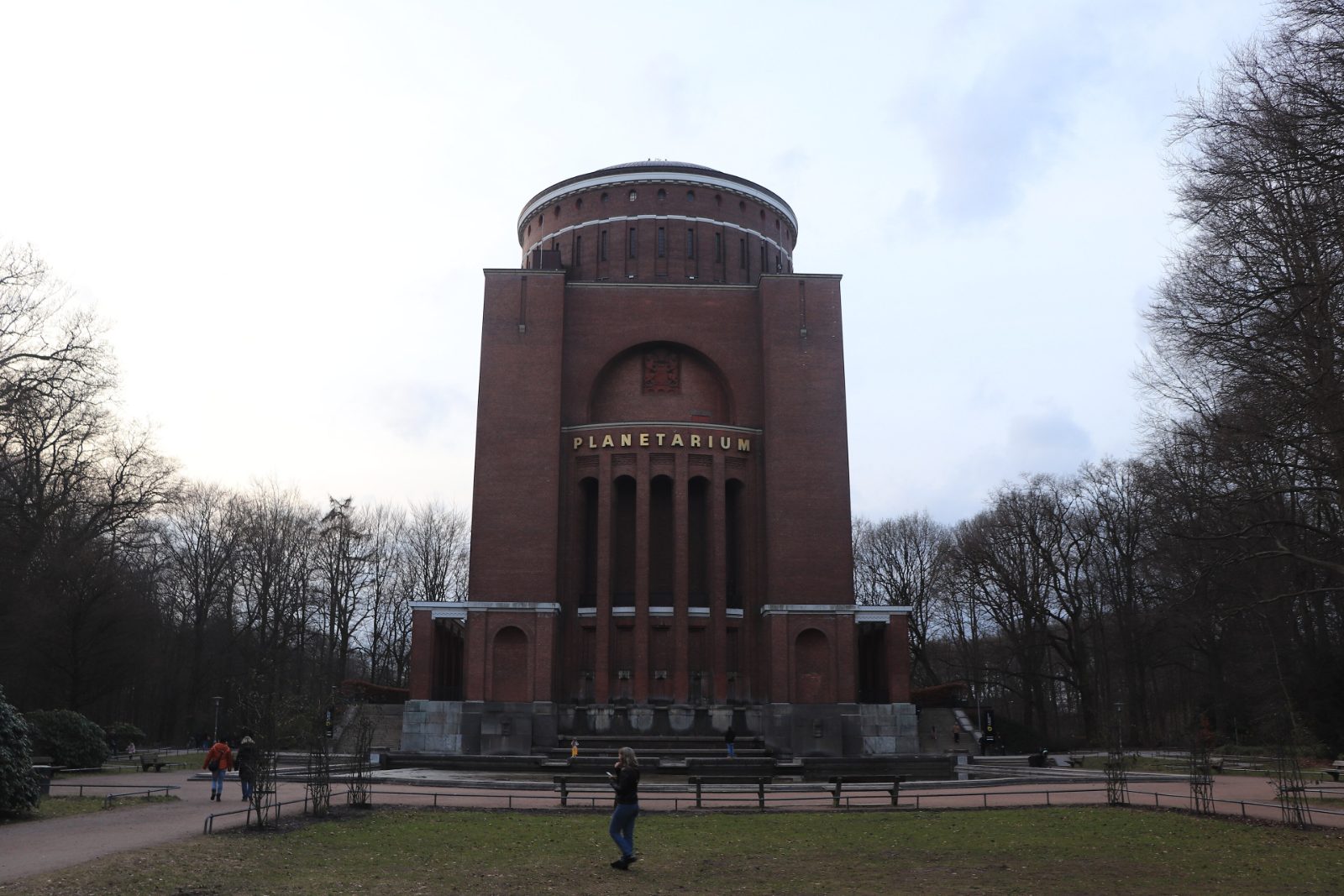
The tower was built in 1912–1916 to hold water, but did so only until 1924; the planetarium opened inside it in 1930. Its roof, seen here from above, is about 27 m across, over a dome of 20.6 m.
With a Sun 27 m across, the planets at the same scale:
| Planet | Across | From the Sun, on average |
|---|---|---|
| Mercury | 9.5 cm | 1.12 km |
| Venus | 23.5 cm | 2.10 km |
| Earth | 24.7 cm | 2.90 km |
| Mars | 13.1 cm | 4.42 km |
| Jupiter | 2.71 m | 15.1 km |
| Saturn | 2.26 m | 27.8 km |
| Uranus | 98.3 cm | 55.6 km |
| Neptune | 95.5 cm | 87.5 km |
One scale for everything
A scale model of the Solar System shrinks the Sun, the planets and the distances between them by the same factor. Choose a size for the Sun, or for any planet or moon, and everything else follows from that one number: put the Sun somewhere you know, and the map draws every orbit around it.
Almost every picture of the Solar System uses two scales at once: one for the sizes, so that the planets can be seen, and a far smaller one for the distances, so that they fit on the page. That is why the picture most of us carry in our heads is wrong. With a single scale the planets turn out tiny and very far apart, and most of the model is empty space, as the real thing is.
Why the planets come out so small and so far
The Sun is 109 times as wide as Earth, and Earth is about 11,700 of its own widths away from it. Make the Sun as big as the 13-metre dome of the planetarium in Zielona Góra, and the rest falls into place:
| Size | From the Sun | |
|---|---|---|
| Earth | 11.9 cma small melon | 1.40 km |
| Jupiter | 1.31 mas tall as an eight-year-old | 7.27 km |
| Neptune | 46 cma beach ball | 42 km |
The Moon would be a 3.2 cm ball, 3.6 m from Earth. Between the planets there is nothing to see for kilometres, and the nearest star, Proxima Centauri, would be some 375,000 km from the dome, almost as far as the real Moon is from us.
How to read the map
- The thin line
- Each planet’s thin line is its real orbit, with the planet where it is on the chosen date. The line is slightly off centre, because the orbit is an ellipse and the Sun is not at its middle.
- The band
- When you arrange the planets by hand, each orbit becomes a band. Its inner edge is the planet’s closest approach to the Sun (perihelion), its outer edge the furthest (aphelion). With a 13 m Sun, Earth’s band is 47 m wide and Mars’s nearly 400 m. Anywhere inside it is a distance the planet really reaches at some point in its year.
- The dashed line
- Drawn with the band: the average distance, the semi-major axis, the figure that tables give as a planet’s distance from the Sun.
- North, and the way round
- North on the map stands for one fixed direction in space: towards the point in the sky where the Sun sits at the March equinox. The planets travel anticlockwise, as they do when seen from far above Earth’s North Pole. This is a convention, not your town’s sky; it is the same for every model, so that two of them can be compared: every March Earth is due south of the Sun, every September due north.
- By date, or by hand
- Unless you choose otherwise, every planet is where it really is today, worked out from JPL’s orbital elements; the play buttons run the date forwards or backwards so you can watch them go round. Or arrange them yourself: at the bottom of the panel beside the map, “Arrange the planets by hand” lets you drag each planet to a spot inside its band, such as a park or a school playground, and the link keeps it there.
- Moons
- Moons go round their planets at their real distances, drawn flat on the map. Our Moon is placed by a short lunar theory and is close to where it really is; the others move at their average speed on a circle, so their distance from the planet is right and their place on that circle approximate. With a 13 m Sun, most of them stay within ten metres of their planet; Iapetus, the furthest out, is 33 m from Saturn.
- Dwarf planets and belts
- Ceres, Pluto, Haumea, Makemake and Eris, with the asteroid belt and the Kuiper belt, are behind a switch, because they take the model a long way out. With a 13 m Sun, Pluto swings between about 41 and 68 km from the dome, and Eris goes out to some 136 km.
- Spacecraft
- Twelve spacecraft, from Pioneer 10 to Europa Clipper, behind a switch of their own: each where it is on the chosen date, with the path it has flown since launch when you pick it. A craft circling a planet is drawn on that planet. They hide while you arrange the planets by hand, and on dates past the end of their published paths.
Light at this scale
Light from the Sun takes 8 minutes 19 seconds to reach Earth. Slow it down by the same factor as everything else and it keeps that timetable in every model, large or small: 8 minutes 19 seconds to Earth, about 4 hours 11 minutes to Neptune.
What changes is how fast it seems to go. With a 13 m Sun, light moves at about 10 km/h, the pace of an easy jog: run beside it from the dome and you could keep up as far as Earth. With a 1 m Sun it creeps along at under 1 km/h; with a 100 m Sun it travels at 77 km/h, like a car on a country road. The map can send a beam of light out from the Sun, so you can watch it cross the orbits.
Build one in your town
A scale model needs little more than a Sun and a sign for each planet, and walking from one to the next explains distance better than any picture.
Choose a Sun you can show.
Something round that people can see and point at: a planetarium dome, a fountain, a roundabout, a circle painted on a square, a ball in a school’s entrance hall. Measure it and give the map its size. Or start from a planet: a football as Jupiter gives a Sun just over 2 m wide.
Pick a spot inside each band.
Press “Start arranging” at the bottom of the panel beside the map, and each planet gets its band. Look inside it for public places that are easy to reach, such as parks, schools, libraries and squares, and move the planets there; the link keeps every choice.
Give each planet a sign.
Its size in the model beside its real diameter, its distance from the Sun and how long light takes to get there. A ball of the right size next to it does most of the explaining.
Walk it.
Go from the Sun outwards before you fix anything in place. Paths are longer than the straight lines on the map, and the walk is the point: by Mars, everybody has understood how empty space is.
A worked example: in Zielona Góra, project no. 62 in the city’s participatory budget would make the planetarium’s 13-metre dome the Sun and set out the planets from Mercury to Jupiter across the city at the same scale. See the proposed route and sculptures.
Accuracy and sources
Sizes, distances and orbital periods of the planets come from NASA’s planetary fact sheets. Each diameter is the mean one, so Jupiter, which bulges at its equator, is a 1.31 m ball beside the dome rather than 1.33 m. Moons come from JPL’s Solar System Dynamics; the dwarf planets from JPL’s Small-Body Database and NASA, with the sizes of Haumea and Eris from published occultation measurements. The spacecraft come from JPL’s Horizons System, which publishes each mission’s own trajectory; where its tables end, we carry the five leaving the Solar System on in straight lines.
Positions on a date come from JPL’s Keplerian elements for approximate positions of the major planets (E. M. Standish), fitted for 3000 BC to AD 3000 and best between 1800 and 2050. In that window no planet is more than about ten arcminutes from its true direction, under 40 m with a 13 m Sun. Further from today the error grows, to a few hundred metres for the outer planets at that scale, and the page offers no dates outside the elements’ range. The dwarf planets other than Pluto follow simpler orbits fitted to JPL’s data for our own time, which grow less exact the further you go from today.
Distances on the map are straight lines, as the crow flies. The map itself comes from OpenStreetMap, the satellite photos, if you switch them on, from Google Maps, and the town search from GeoNames.
Examples
Open one to see the whole model in a real place.
Planetariums
Europe
- Vienna, the Zeiss Planetarium
- Brussels, the Planetarium
- Prague, the Planetarium
- Brno, the Observatory and Planetarium
- Copenhagen, the Tycho Brahe Planetarium
- Berlin, the Zeiss Major Planetarium
- Jena, the Zeiss Planetarium
- Bochum, the Zeiss Planetarium
- Hamburg, the planetarium in a water tower
- Nuremberg, the Nicolaus Copernicus Planetarium
- Athens, the Eugenides Planetarium
- Budapest, the Planetarium
- Milan, the Ulrico Hoepli Planetarium
- Amsterdam, the Artis Planetarium
- Zielona Góra, the Wenus planetarium
- Chorzów, the Silesian Planetarium
- Warsaw, the Heavens of Copernicus
- Toruń, the planetarium in an old gasholder
- Olsztyn, the Planetarium
- Lisbon, the Navy Planetarium
- Madrid, the Planetarium
- Pamplona, the Planetarium
- London, the old London Planetarium
- London, the Peter Harrison Planetarium
- Armagh, the Planetarium
North America
South America
Asia
Buildings
Questions
Is it free? Do I need an account?
It is free, with no account, no sign-up and no advertising. Open the page and put the Sun down.
What does the page keep about me?
Nothing on a server. Your model is kept only in the page’s address, after the # sign, and browsers do not send that part of an address to any server. The street map’s tiles come through slowsquares.com, so no map company sees your visit. Only if you switch on the satellite photos, and say yes when the page asks, does your browser connect to Google Maps. The page counts visits and a few anonymous actions, such as whether the Sun was placed by search or by tapping the map, never where.
Does it use my location?
Only if you ask the page to find you, and only after your browser has asked your permission. The position goes into the link, rounded to about ten metres; it is never sent to us or stored, and the map only loads the tiles around it, as it does for any place you look at. Whoever you send that link to will see the place.
How do I share a model?
Use the Share this model button, or copy the address. It carries everything: where the Sun is, its size, the date if you picked one, and any planets you placed by hand. Whoever opens it sees the same model.
How big or small can the Sun be?
Give any body a size and the Sun follows, anywhere between 1 centimetre and 300 metres. With a 1 cm Sun, Earth is a speck a tenth of a millimetre wide, 1.07 m away; with a 300 m Sun, Neptune is almost 1,000 km out.
How accurate are the positions?
Between 1800 and 2050 each planet is within about ten arcminutes of its real direction, less than 40 metres with a 13 m Sun. Further from today the error grows, and the page offers no dates before 3000 BC or after AD 3000.